
Being 23 on an educational trip that feels like a business trip is a pretty cool feeling. First, I get to learn about this amazing industry I didn’t know existed, meet amazing people, and explore beautiful cities on my time off. Second, I get to wear some killer business casual meets European fashion outfits AND the weather is beautiful. Okay, today is going to be busy. I have 2 presentations this morning and then have to hop on the fast train to Bologna!
Lobbying and Advocacy
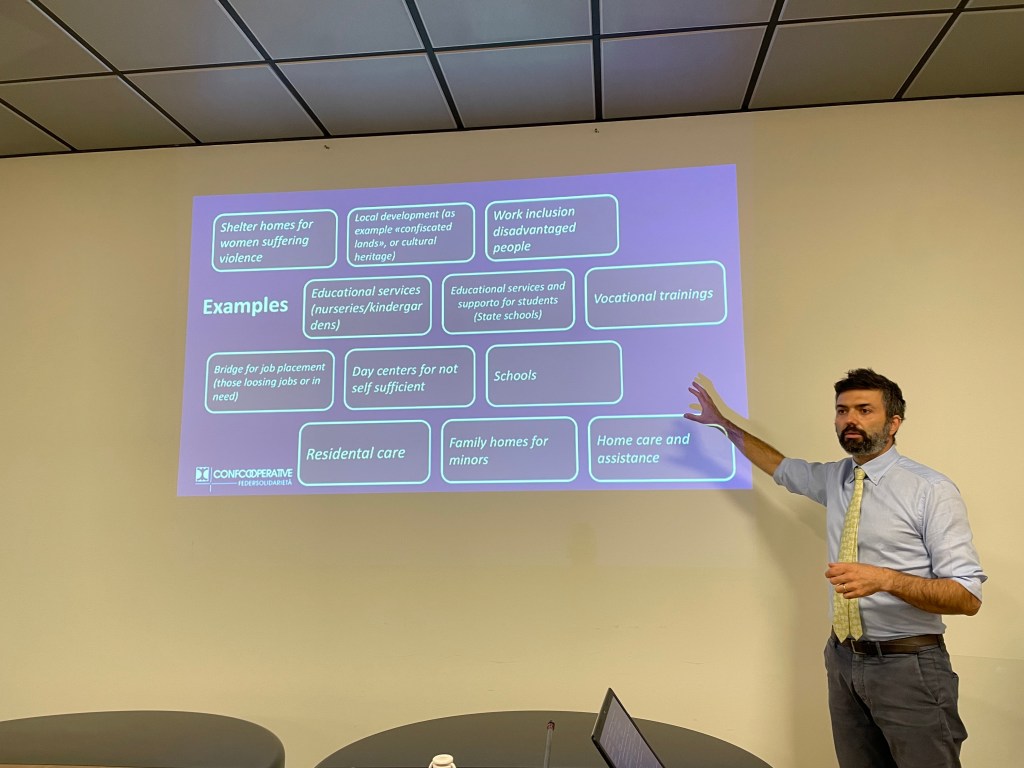
I woke up excited to go to my next presentation which was from Valerio Pellirosi, who I met the day before, and he gave an excellent presentation on social cooperatives. Some background on Valerio, he studied law, international relations, and politics. Buckle up ladies and gents we have a lot more information to go over.
SO…different types of co-ops. I thought I had the structure of co-ops down pat after yesterday but there is more. Within the 9 sectors, social cooperatives is one of them and there is a big difference between a social co-op and the other types. Social co-ops are the youngest of the types and were created to address special needs and circumstances. They advocate for and aid in helping all of those who are at a disadvantage. For example, recovering addicts, the elderly, children and adults with disabilities, ex-prisoners, and many more. Social co-ops are in the middle of healthcare and the industry of crafts and services. While some do provide services while incorporating those at a disadvantage, like the restaurant, others provide care. An example of this would be a day care center for those who are disabled or the elderly. Those that provide care are type A, while services provided by a co-op made up of at least 30% of those at a disadvantage are type B. Social co-ops really didn’t begin to come up until the 80s when the realization hit at the lack of resources provided by the state for those in need of care.
Social co-ops are non-profits and this isn’t just by choice. It is by law, stricter laws than other co-ops, that the profits be reinvested. Social co-ops also are multi-stakeholder. They can have users (consumers), workers, volunteers, as well as both public and financial institutions involved. There is also a lot of local development involved. An example of this I found to be very cool is that of taking confiscated goods from the community and returning them as an aid for those in need. The example given by Valerio was, say the house of a mafia boss who was arrested would then be made into a daycare or some other resource for others. Social co-ops are typically smaller than others, but that does not mean they can’t be extensive. For example, a wine co-op in Italy produces 7% of wine consumed throughout Italy. These co-ops are typically town or region based which has its pros but because Italy is so spread out it can be hard to bring these co-ops, care co-ops specifically, into regions with a much more spread out population, say in the mountains.
After learning all about social co-ops themselves, Valerio explained the connection between those and what happens in regard to the EU, or European Union. Valerio worked in Brussels, where the EU parliament is located and where I will be visiting next week, before he came to Rome to work for Confcooperative. The other aspect of social co-ops rather than providing service or care, is lobbying for change to the EU, or the highest form of government. There is a lot of advocatory work from Italy to the EU and in 2011 it paid off in a large way. In 2011 the Social Business Initiative was passed which was the first point of recognition by the government for social co-ops. Then in 2014 the Public Procurement Directive was passed which allowed for reserved contracts. To the best of my knowledge, this means that there are specific regulations each entity must meet in order to acquire the contract. This limits competition and favors those entities that are up to standards and advocating for social economy. While Italy was already doing this, and was a huge part of getting the movement passed, it was a landmark for social cooperatives all throughout the EU. Valerio himself was a large part of lobbying for these movements in 2010.
Valerio mentioned something about lobbying that caught my attention and I didn’t fully understand. When speaking about lobbying he noted that they don’t actually use the term “lobbying.” Due to language it was hard for me to understand the difference between the definition of lobbying per USA standards, which Valerio commented USA invented, and what happens in Italy. The difference is that change takes a very long time and requires a lot of patience. Big differences can be made in an instant but it is dependent on the opportunities that come along and so you must be ready at any instant to take those opportunities. This also means those lobbying must be incredibly knowledgeable of the work being done, what is already in place, what exists in other places, and the goals at which they are trying to reach. It is that of a full time job and requires around the clock efforts in order to make actual change.

Co-ops in Healthcare, Co-op Sanita
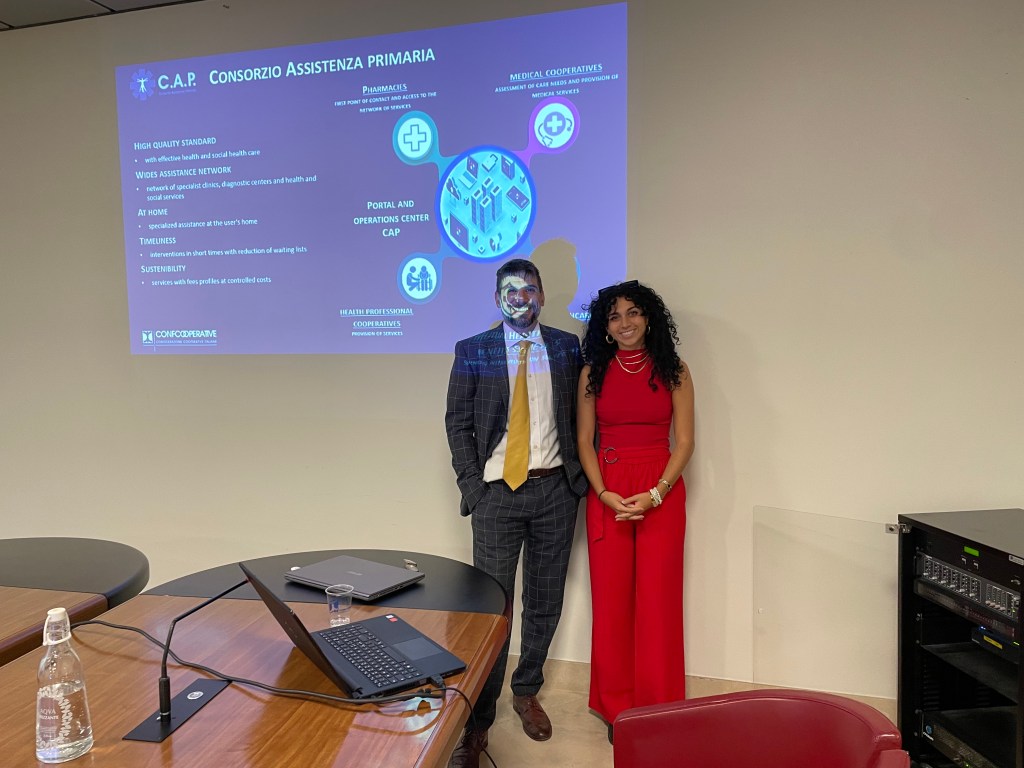
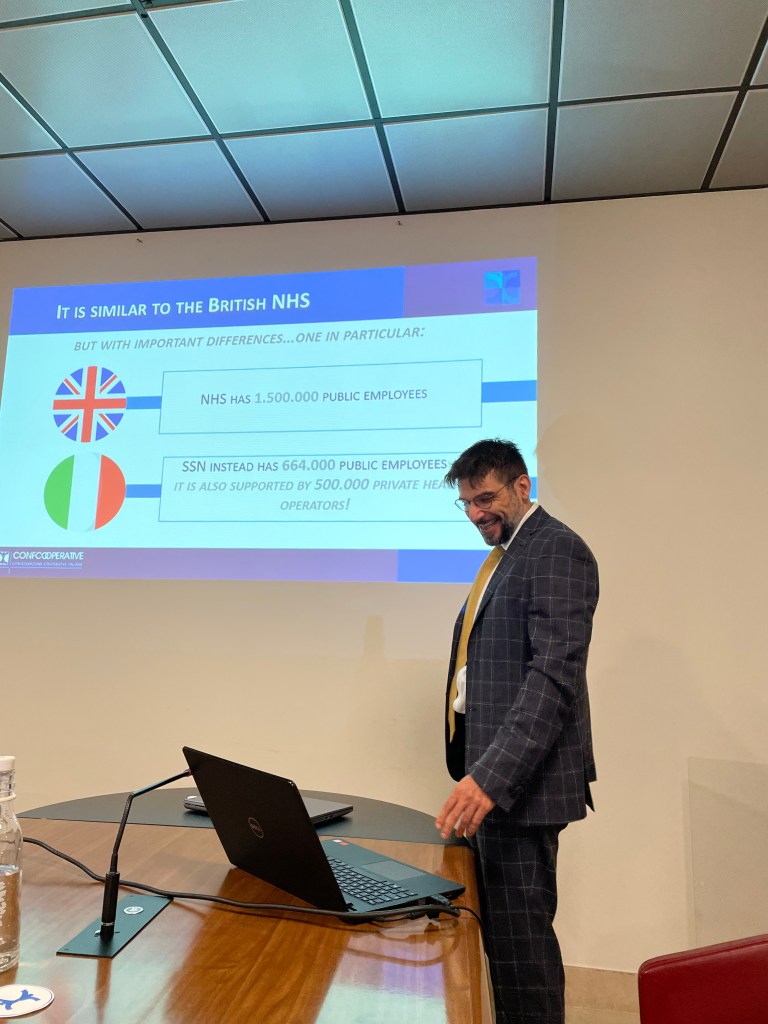
After Valerio’s presentation I was able to sit down with Marco Battisti who took the time to present information about the healthcare system and the role that co-ops play in said system. Let’s start with some background. The Italian public healthcare system was reformed in 1978 and remains relatively the same today. Healthcare is funded by general taxation of Italy’s residents, and there is a mix of private and public providers. Private providers are an out-of-pocket expense, and they make up almost 30% of the healthcare system, while the public sector makes up 70%. The public system is prided on the fact that all those employed are very qualified even though it is inexpensive or even free. Though the healthcare system provides great care, there are flaws. Often the public system cannot provide all services, but the “original sin” of the system, as they call it, is that it is entirely centralized around hospitals. Side note: In Italy you go to the hospital for everything from a cut, to a cold, to a broken bone. There are no doctor’s offices like there are in the US. So yes, the care is great in the hospitals, but the entire system is only set up for acute care.
There are 14 million elderly people in Italy and 4 million live alone. 4.2% have dementia or Alzheimer’s and only 2.8% of the elderly in total are in long term care or receive at home care. The culture in Italy promotes taking care of your elders rather than putting them in a home, but even then the system is overwhelmed by the elderly that need care and there isn’t even close to enough care available. This is where healthcare co-ops come into play. Keep in mind the federation, or sector, of healthcare co-ops in ConfCooperative is the newest, only beginning in 2010. Their main goal is to shift Italian healthcare policy to make territorial healthcare services as the core of the new system. They work to provide at-home care, long term stay care, rehabilitation facilities, and more. The biggest example of a co-op that Marco explained is Co-op Sanita. This co-op provides pharmacists, other medical co-ops, health professionals such as doctors and nurses, and healthcare benefit societies as one big network. Another important thing to understand about Italian healthcare is that it typically begins with a pharmacist. In the US the pharmacist is only in charge of our prescriptions, but in Italy they are basically as qualified as a physician. If you need a specific medical service, you go to the pharmacist and ask for advice or for medical counseling on treatment before you go to the hospital and then they put you in contact with a physician or facility. Pharmacists actually hold the same medical ruling as doctors and nurses and in 2009 a law passed allowing pharmacists to open their own territories. Co-op Sanita consists of almost 140,000 members and has 3.5 million users/patients.

Bologna
After cutting it close while wrapping up my presentation with Marco, I quickly popped back into my hotel to grab my overnight bag before hopping on a train to Bologna, Italy. My train arrived at around 3 pm and I decided to walk 30 minutes to my Air BnB-a mistake considering it was 90 degrees. Once I cooled down a bit I made my way over to the ConfCooperative headquarters of the Emilia Romagna region where I met with Davide Pieri. With a full plan for the following day, Davide and I sat down for about an hour and a half for an introductory meeting. As a very personable man, I learned a lot about Davide, the Emilia Romagna region, and some very cool history of cooperatives in Italy.
For some background, Italy is split up into regions and each region contains a diverse portfolio of co-ops, but some specialize in one more than the other. In Emilia Romagna, the agri-food, or agriculture, co-op is the most prominent. They are very well known for their wine as well as amazing parmesan cheese, Parmigiano Reggiano. Without these crucial co-ops within the agri-food sector, the economy of Emilia Romano would not survive. The co-ops within the region account for 70% of all wine sold in the region! Another staggering statistic is that the agri-food sector brings in 9.8 million in revenue out of the total 13 million in revenue in Emilia Romagna. Now, I am familiar with parmesan cheese of course, but I had no idea there was a “real” type of cheese as opposed to some imposters that you see at the grocery store. I say “real” because if it is not specifically Parmigiano Reggiano made in the Emilia Romagna region, it’s not marked as the real deal. There are very strict regulations within the agricultural sector from the production to the care of the animals to the aging process. As an American, this was unfamiliar altogether, as our common foods are full of preservatives and many chemicals. I will get into much more detail of the wonders of parmesan cheese in tomorrow’s blog, but it’s an important background.
Davide has been working with ConfCooperative for many years and could not express enough how happy he is to do the work that he is doing. I rarely come across people who fully love what they do, which was inspiring, but even more so when he explained his position. Davide serves over 25 people on both the national and local level in Italy. He acts as a liaison and managing that many people certainly comes with a lot of stress. He explained he works through the stress by always smiling, closing his laptop at the end of the day and keeps it shut, and most importantly, because his morals are fulfilled with his line of work. He basically works for the entire economy of Emilia Romagna and isn’t unhappy about it, leaving me thoroughly impressed.
Let’s dive into some of the history. I mentioned in the previous blog post that there are 3 large co-op organizations within Italy, but before talking with Davide I didn’t think much of it. The two largest are ConfCooperative and LEGOP and despite attempts to merge the two, it has not been done due to the origins of each. One branch originated from communism while the other from the church. ConfCooperative is considered a “white co-op” because it originated with the church and they used to wear white, while LEGOP is “red” because of communist origin. Having had much time pass since they began, their differences are not as defined, but with deep origins, they remain separate. Even though my knowledge of Italy’s history is minimal, I always find it interesting to learn why things are the way they are and appreciate Davide taking the time to give me a mini history lesson. Another interesting piece I learned about is “unrecognized co-ops.” These are co-ops that fly under the radar and evade taxes. They are not as common as recognized co-ops, but overall they are a major threat to the reputation of co-ops. Co-ops are amazing entities that really prioritize advocating for something better, but overall public awareness is not where it could be. I spoke with Davide as well as most others I have talked to so far, and they all say that most people in older generations know of co-ops but do not have extensive knowledge and younger generations are even more in the dark. That brings me to another important piece of Italy’s culture. Change is very slow, as the lifestyle is, in Italy and it affects those under 40 in ways I did not expect. Similar to the co-op feminilis, mostly for women, young cooperators are separated as well. Anyone under 40 is considered young by Italian standards. Americans’ would be thrilled by the idea of this, but it sat a bit funny with me. It is very hard to start a career until your late 20s and even then, from what I gather, it’s not until you’re over 40 that you are viewed with the same competence as the typical workforce. Overall Italian society is both male driven as well as driven by those over 40 years old. As I said, change is slow. The fact that there is a sector for young cooperators and women is amazing progress, but I can’t help but wonder if there is some untapped potential there. The major line of my thought process here is marketing. I have stated that the general public knowledge of co-ops is not nearly as strong as it should be. Co-ops provide amazing opportunities and do important work. If those younger than 40 were allowed to climb the ladder faster, new perspectives would be added as well as new marketing initiatives. My goal of saying this isn’t to change Italy’s societal norms, but rather adding my further thoughts to my experience.
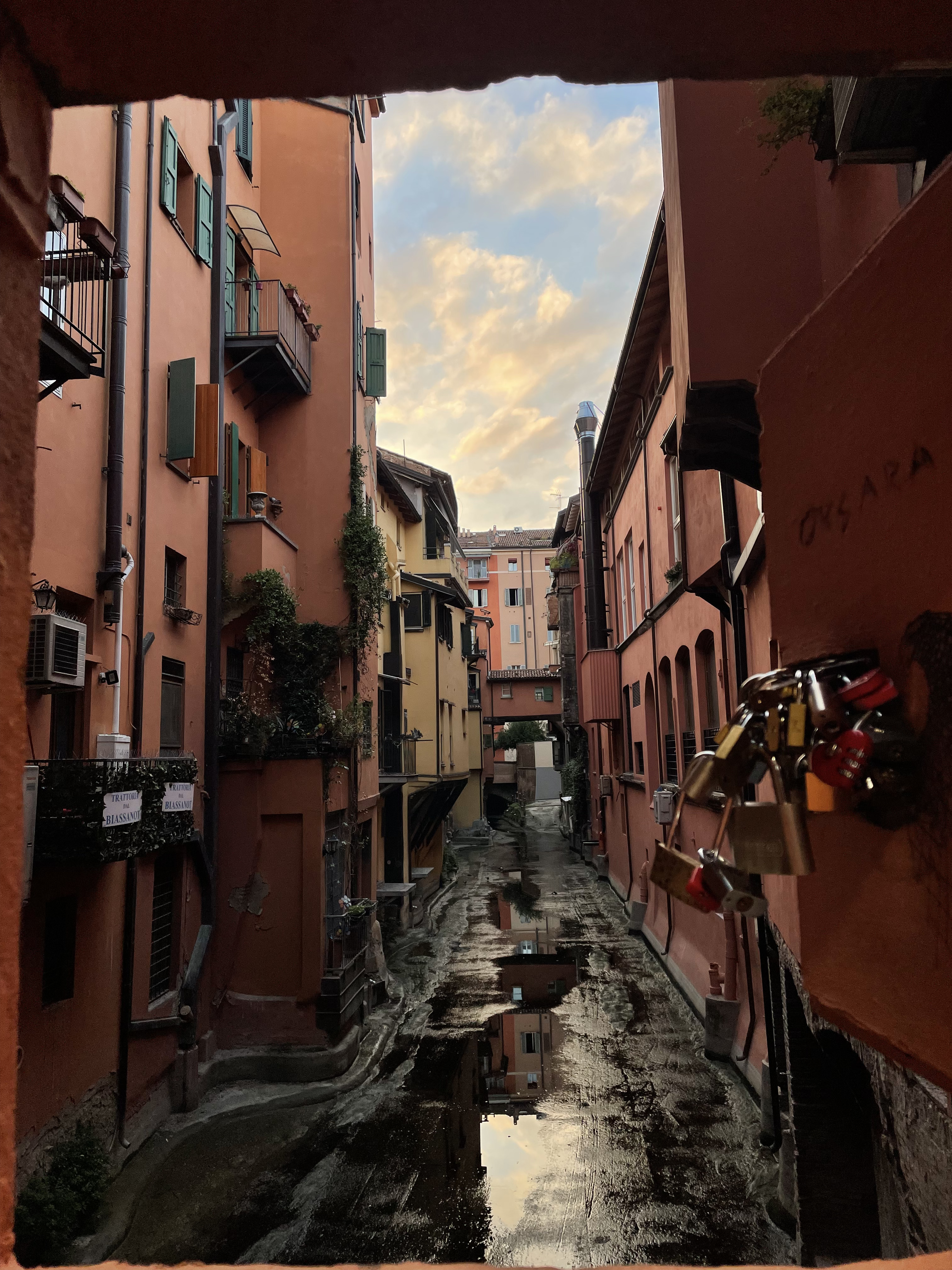
Once we wrapped up our meeting I went into the center of Bologna to do some exploring. I made sure to see the Finestrella di Via Piella, a small window in the middle of a small street with a surprising view. I then did some vintage shopping (my favorite thing to do) and made the decision to purchase a stunning Moschino blazer. In every city I visit when traveling the first thing I do is seek out the closest vintage or thrift shop. I walked to one and found 4 more in the same area. Needless to say I lost track of time and by the time I finished the sun had set. I asked the owner of one of the shops for a restaurant recommendation for a simple dinner and I am so thankful that I did. She recommended Osteria dell’Orsa, a restaurant I had walked by earlier and was pretty empty, but by 8 pm the place was packed. Throughout this trip, I grew to enjoy eating alone and one of the biggest benefits is almost any restaurant has room for a solo. The wait was an hour for a table, but the very nice man working there found me a seat at the bar. I ordered a nice glass of white wine with a Bolognese lasagna and when I tell you this was the best lasagna, Bolognese, overall meal ever! I did not want it to end and wish that I could’ve eaten there for the entirety of my trip. 10/10 recommend.



 International Cooperative Immersed
Leave a comment